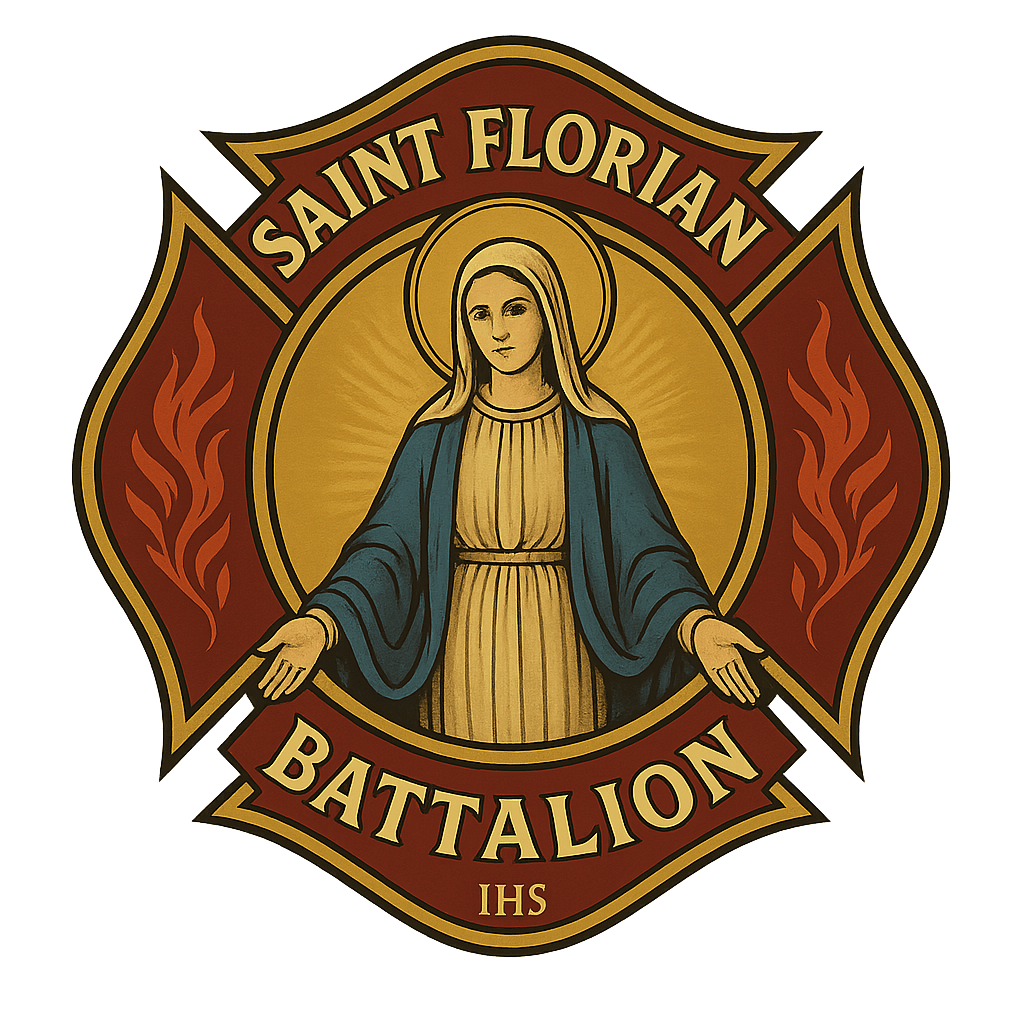
Why May Belongs to Mary:
A Catholic Firefighter’s Reflection on Marian Devotion
If you’ve ever stood in front of a burning building, you know what it means to rely on someone greater than yourself. There are moments in this job when the smoke is too thick, the weight too heavy, or the grief too real. In those moments, it’s not just about training or muscle—it’s about grace. And many of us, in that breath between action and aftermath, have whispered one name: Mary.
It’s no accident that firefighters, soldiers, and first responders often wear medals of the Blessed Virgin Mary. She’s not just a symbol—she’s a mother. A shield. A quiet companion in the chaos. And during the month of May, the Church gives us a chance to remember just how much she means.
THE ROOTS OF MARIAN DEVOTION:
Devotion to Mary didn’t start in a vacuum. From the earliest centuries of the Church, Christians honored the woman who bore God in her womb. The first recorded prayer to Mary, the Sub Tuum Praesidium (“Under your protection”), dates back to at least the 3rd century. That means Christians were calling on her intercession while the Church was still underground—literally hiding in the catacombs.
By the time of the Middle Ages, Marian devotion had woven itself into the very heartbeat of Catholic life. Cathedrals were dedicated to her. Processions filled the streets in her honor. The Rosary took shape as a powerful prayer, especially for men and women facing danger. It became a spiritual weapon—for monks, for crusaders, and yes, for anyone walking into the unknown.
She was never worshipped—only honored. Because no one points to Christ more clearly than His mother.
WHY MAY?
The Church’s devotion to Mary spans every month, but May holds a special place. In the Northern Hemisphere, May is the month when life returns. Flowers bloom, trees bud, and the world begins to feel alive again. And for centuries, Christians have seen that beauty as a reflection of Mary—the one who brought Life Himself into the world.
It was in the 13th century that May began to be linked with Mary in more intentional ways. By the 18th and 19th centuries, it became common to crown statues of Mary with flowers, sing hymns in her honor, and set up “May altars” in churches and homes. These weren’t just sweet gestures—they were acts of deep love from people who saw in Mary a gentle strength, a mother’s heart, and a guiding hand in the darkest hours.
May processions became especially popular in working-class Catholic communities—where faith was often all people had. They weren’t theologians or scholars. They were farmers, laborers, factory workers… and yes, firefighters. People like us.
WHY IT MATTERS TO FIREFIGHTERS:
Let’s be honest: this job will break you if you try to carry it alone. The things we see—the things we carry home in silence—don’t always find a place in therapy or even in brotherhood. But prayer? That can go anywhere. And Mary is the kind of mother who meets you where you are.
She was there at the foot of the Cross. She understands pain. She watched her Son suffer and didn’t run. That kind of courage isn’t abstract—it’s real. It’s the kind you need when you’re working a fatal accident at 2 a.m. or when you’re knocking on a door to deliver news no family wants to hear.
Wearing her scapular, carrying her medal, or praying her Rosary—it’s not superstition. It’s not just tradition. It’s about staying close to a mother who knows the cost of love.
LIVING MAY WITH MARY:
So how do you honor Mary this May? You don’t need a procession or a Latin chant. Just start small:
- Pray the Rosary during downtime at the station or on your commute.
- Set up a small image or statue of Mary in your locker or near your gear.
- Offer your shift for her intentions—especially on her feast days.
- Learn one new Marian prayer or reread her part in Scripture.
And above all, talk to her. Like a son. Like a daughter. Like a firefighter leaning on the only mother who never sleeps.
SHE’S NOT JUST FOR THE PIOUS:
Mary isn’t just for old ladies in pews or monks in cloisters. She’s for the tired, the bruised, the ones who run toward danger because someone has to. She’s for us.
So this May, let her be more than a statue or a name in a prayer. Let her be the mother who walks with you into the fire—and back out again.
Because in this line of work, you don’t just need backup. You need grace. And no one brings you to Christ like Mary does.
“Holy Mary, Mother of God, pray for us sinners, now and at the hour of our death.”
 saintflorianbattalion.org
Leave a comment